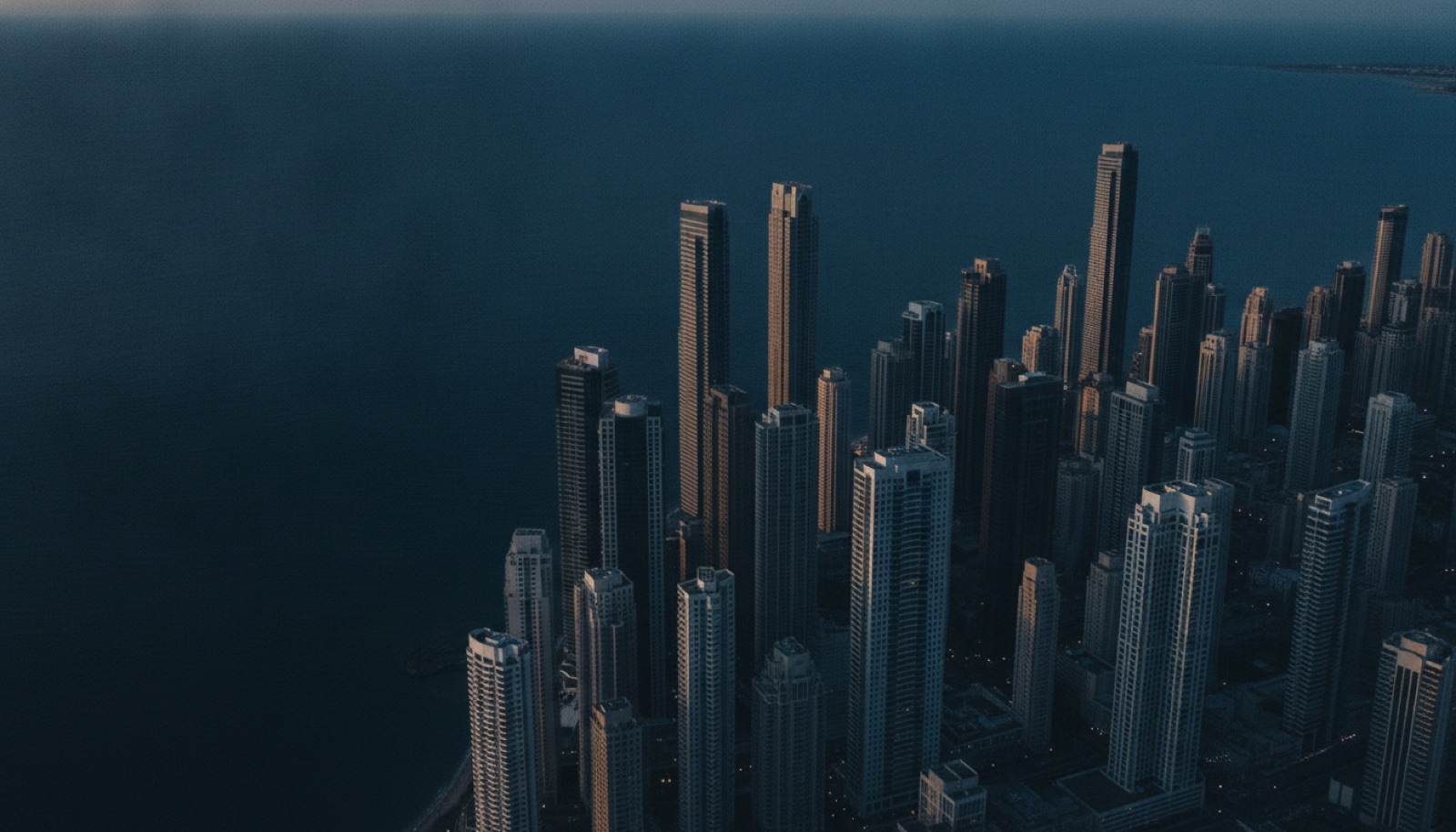
Beachfront Dubai Compared: Palm vs Emaar Beachfront vs Dubai Islands
Three beaches within a few kilometres, three completely different theses. The fixed-supply trophy, the institutional masterplan, and the growth frontier, priced, yielded and matched to the right mandate.
Three beaches, three theses
Dubai's beachfront is not one market. Palm Jumeirah, Emaar Beachfront and Dubai Islands sit within a few kilometres of each other, and price, yield and buyer profile diverge sharply. Here is the comparison we run before pointing a client at any of them.
Palm Jumeirah: the established trophy
The original, and still the most liquid ultra-prime beachfront address in the city. Supply is effectively fixed, the fronds are built out, which is the entire investment case. Apartment entry now starts around AED 2.8 to 3.5M for a one-bed on the trunk; signature and branded stock (Six Senses, Como, One Palm, Armani Beach) runs into the tens of millions. Villas on the fronds trade from roughly AED 15M to well over AED 100M.
- Gross yield: 4.5 to 5.5% on apartments; villas lower.
- Short-let: among the strongest ADR in Dubai; genuinely short-let friendly.
- The case: scarcity, brand density, the deepest ultra-prime resale liquidity in the country.
- The catch: you are buying at a mature price. Growth from here is defence and yield, not the explosive appreciation of the early years.
Emaar Beachfront: the master-planned prime play
A gated island district between the Marina and the Palm, wholly Emaar-built, with a private beach and a curated tower line-up (Beach Isle, Sunrise Bay, Address, Beachgate, Palace Beach). It is prime, new and professionally masterplanned, the institutional beachfront.
- Entry: one-beds around AED 2.6 to 3.2M; sea-view and higher floors above.
- Gross yield: 5 to 6%, marginally ahead of the Palm on comparable stock.
- The case: Emaar delivery record, Marina-adjacent lifestyle, a strong off-plan-to-handover track record, cleaner rental management than the fragmented Palm.
- The catch: a defined-supply masterplan, but not fixed like the Palm, Emaar continues to release phases, which caps scarcity-driven upside.
Dubai Islands: the growth frontier
Nakheel's redevelopment of the former Deira Islands, five islands off the historic waterfront, a long-horizon masterplan of beaches, marinas, hotels and residences. This is the early-stage entry point of the three.
- Entry: the lowest of the trio, one-beds from roughly AED 1.6 to 2.2M, with beachfront and branded launches above.
- Gross yield: 6 to 7% projected on current pricing, the highest here, because the price base is lowest.
- The case: ground-floor pricing on a government-backed masterplan, the highest yield and the most appreciation headroom if delivery and infrastructure land as planned.
- The catch: it is early. Much is off-plan, the surrounding infrastructure and beach clubs are still maturing, and the liquidity and rental depth of the Palm are years away. This is a conviction play on Nakheel's execution, not a finished address.
Cost of carry and the letting angle
Service charges track the positioning. Expect roughly AED 22 to 35 per square foot on the newer prime towers at Emaar Beachfront and Dubai Islands, and a wider, older range on the Palm where some early towers carry higher charges and beach-access levies. All three support furnished and holiday-home letting, but the ADR hierarchy mirrors maturity: Palm commands the top nightly rates today, Emaar Beachfront rates strongly on new-build appeal and Marina spillover, and Dubai Islands' short-let market is still forming, promising, but not yet proven at Palm volumes. If day-one rental depth matters to your model, that ordering matters more than the purchase price.
Reading the three side by side
Think of them as a risk curve on the same coastline. Palm is the finished, fixed-supply trophy: lowest yield, lowest growth-from-here, lowest risk, deepest liquidity. Emaar Beachfront is the institutional middle: new-prime, slightly higher yield, capped scarcity, strong developer covenant. Dubai Islands is the frontier: highest yield, highest appreciation headroom, and the delivery and liquidity risk that always rides with early-phase masterplans.
Which one, for whom
- Wealth preservation, end-use, resale certainty → Palm. You pay the mature price for the most liquid beachfront exit in the country.
- Balanced prime with a developer you can underwrite → Emaar Beachfront. The closest thing to an institutional beachfront allocation.
- Yield and growth with a longer horizon and appetite for phase risk → Dubai Islands. Enter early, hold through the build-out, accept that finished-market liquidity comes later.
The mistake is comparing headline price per square foot across the three and calling one cheap. They are three points on a risk-return curve, not three versions of the same asset. Match the beach to the mandate, income, preservation or growth, and the choice usually makes itself.
Fifteen minutes with a Reemah advisor turns a thesis into a priced, ranked shortlist.