
Ras Al Khaimah & the Wynn Effect: Al Marjan Island Investment Case
Al Marjan Island prices rose 21% year on year as the region's first integrated casino resort approaches opening. This is the data-driven case for and against the highest-conviction emerging-market play in the UAE.
Ras Al Khaimah has spent two years as the UAE's fastest-appreciating property market, and the reason fits on a single line: the region's first integrated gaming resort is being built on Al Marjan Island. Al Marjan prices rose roughly 21% year on year into 2026, a rate no Dubai community is matching. This is the investment case, examined on both sides.
The catalyst
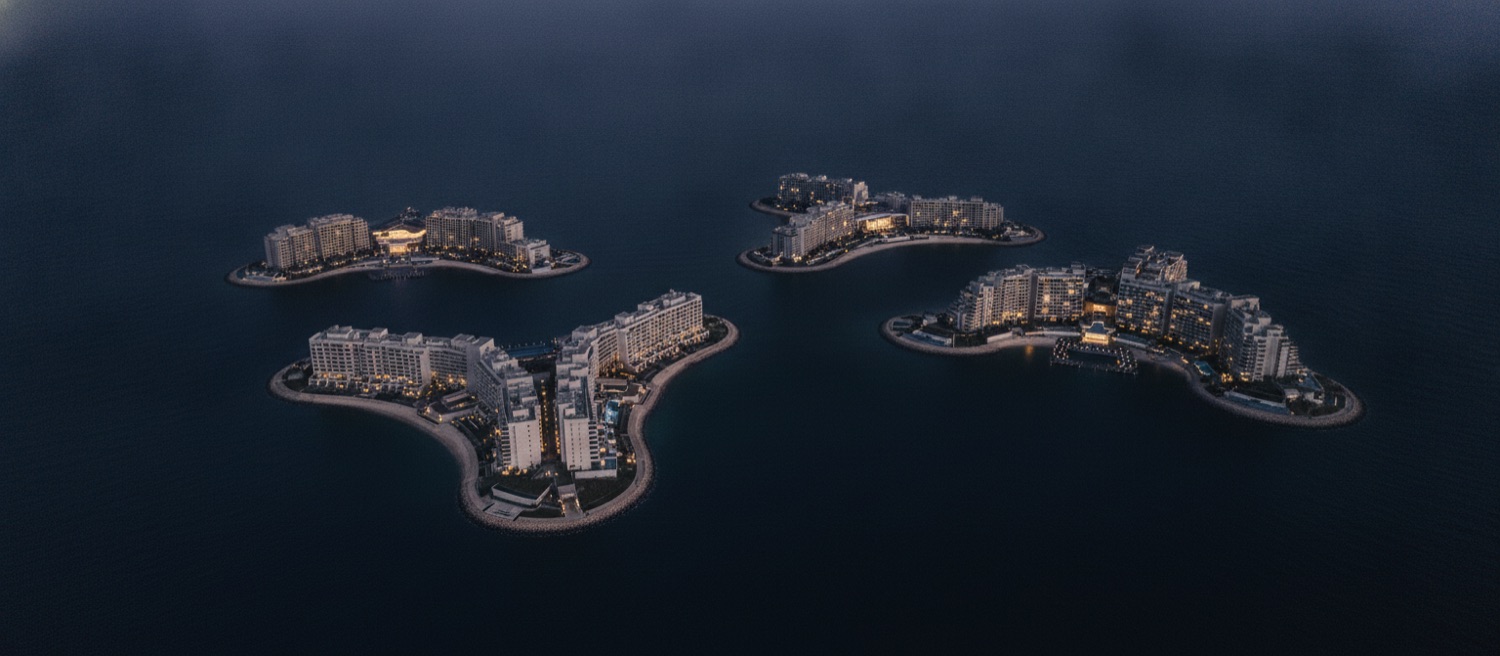
Wynn Al Marjan Island is a multi-billion-dollar integrated resort under construction on Al Marjan, a set of coral-shaped man-made islands off the RAK coastline. It is scheduled to open in 2027, and it will house the first commercial gaming operation of its kind in the UAE, alongside a large hotel, restaurants, and entertainment offering.
The significance is not the building. It is the category. An integrated resort of this scale creates:
- A large permanent workforce needing housing
- A tourism inflow that did not previously exist at this volume
- A short-term rental demand base anchored to a year-round attraction
- A global spotlight on a market that most international investors had never considered
This is the classic pre-opening emerging-market setup: a confirmed, funded, under-construction catalyst with a known completion window, bought before the demand it generates arrives.
The price data
Al Marjan Island has repriced hard.
- Year-on-year price growth: roughly 21%
- Entry pricing still materially below comparable Dubai waterfront
- A dense pipeline of branded and off-plan launches racing to complete near the resort opening
The appreciation is real and it is documented. The question is not whether Al Marjan has moved - it plainly has - but how much of the catalyst is already in the price and how much remains to be captured.
The yield story
The investment thesis rests heavily on short-term rental economics post-opening. An integrated resort drawing year-round tourism creates holiday-let demand that a normal residential community cannot.
- Long-let gross yields on Al Marjan already sit competitively, in the mid-single digits and above
- Short-let yields post-opening are the real prize, on the expectation of resort-driven occupancy
- Entry pricing below Dubai means the yield denominator is lower, lifting the percentage
The bull case is that a well-located Al Marjan unit run as a short-term let after the resort opens outperforms an equivalent Dubai apartment on gross yield, because the demand is anchored to a singular, high-draw attraction with limited nearby supply.
The bull case, stated plainly
- A confirmed, funded, world-class catalyst opening 2027
- 21% year-on-year appreciation already demonstrating the market's response
- Entry pricing below Dubai waterfront for genuine beachfront product
- First-mover exposure to a gaming-anchored tourism economy new to the UAE
- Short-term rental demand that should step-change on opening
This is a genuine asymmetric setup. The catalyst is not speculative - it is under construction with a named operator and a completion window.
The bear case, stated just as plainly
Discipline requires naming what could go wrong, and an emerging single-catalyst market has real risks.
- Supply concentration: a wall of off-plan is launching to hit the opening, and it will complete into a compressed window. Al Marjan could over-build against its own catalyst.
- Single-catalyst dependence: the thesis leans heavily on one resort. Dubai's demand rests on hundreds of drivers; Al Marjan's near-term case rests substantially on one.
- Liquidity: RAK's secondary market is thinner than Dubai's. Exit is easier to underwrite than to execute if sentiment turns.
- Priced-in risk: 21% appreciation means the market is not undiscovered. Some of the opening is already in the entry price.
- Operational unknowns: short-let yield projections assume occupancy and rate levels the market has never actually tested.
The sharpest risk is supply timing, and it rhymes with the Dubai story. A community that launches its entire pipeline to hit a single 2027 opening date hands over into a compressed absorption window. The catalyst is real; the risk is that too much product chases it at once.
How to position
If the thesis is compelling - and for an investor with risk appetite it reasonably is - execution discipline separates the outcome.
- Buy proximity to the resort, not just the postcode - walkability to the attraction is the entire short-let premium
- Favour established developers who will actually deliver on schedule into the opening window
- Underwrite short-let yields conservatively; treat post-opening occupancy as a hoped-for upside, not a base case
- Size the position as an emerging-market allocation, not a core holding
- Watch the launch pipeline - if the supply racing to completion looks excessive relative to the resort's demand, that is the signal to wait
The verdict
Al Marjan Island is the highest-conviction emerging-market play in the UAE in 2026, and the 21% appreciation shows the market agrees. The catalyst is confirmed, funded, and under construction, which is a far stronger footing than most emerging-market stories ever have.
But it is an emerging market, with a single dominant catalyst, a thinner secondary market than Dubai, and a supply pipeline racing to hit one date. The returns on offer are larger than Dubai's precisely because the risk profile is larger. The correct posture is enthusiasm with discipline: buy the location not the hype, underwrite the yields conservatively, and size the position for what it is - a high-conviction bet on a confirmed catalyst, not a core, liquid, diversified holding.
Fifteen minutes with a Reemah advisor turns a thesis into a priced, ranked shortlist.