
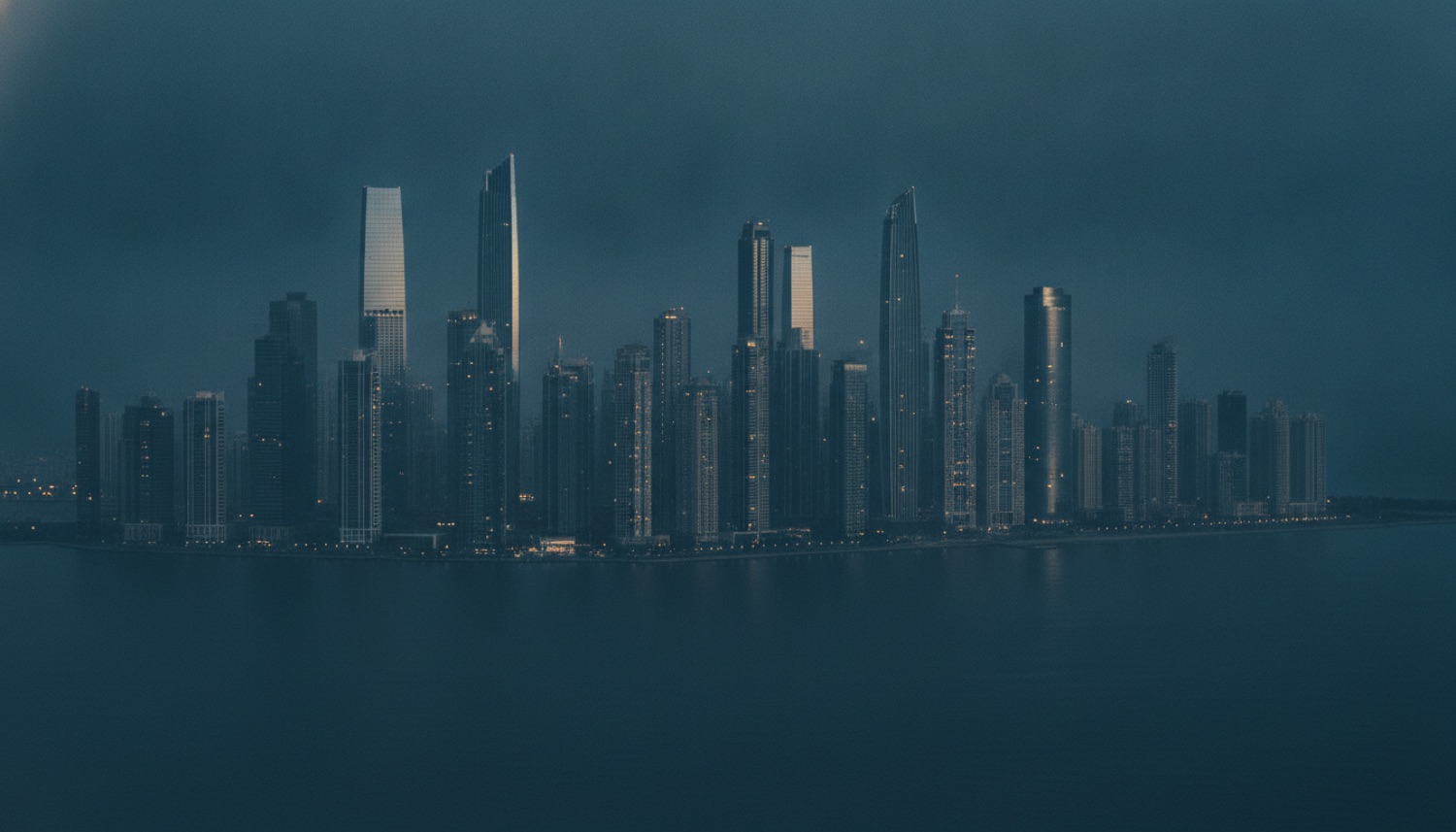
Dubai Real Estate Deep Dive 2026: Price Map, Supply Wave and the 2040 Plan
AED 420bn in H1, off-plan at 68%, and a supply wave meeting a population that grows faster than Dubai can build.
Dubai's real estate market booked AED 419.9bn across 112,850 transactions in H1 2026, with off-plan capturing 68% of deals and average prices up 9%. This deep dive maps price by community, the 2040 Urban Master Plan supply wave, and where the 2026-2028 upside sits, from Downtown scarcity to the Palm Jebel Ali and The Oasis frontier.
The price map: where Dubai's value sits in 2026
Dubai's 2026 price map is a story of widening tiers, not a single average. At the apex sits Palm Jumeirah, where completed villas and branded apartments clear AED 3,800-4,200 per square foot, with trophy fronds trading well beyond. Downtown Dubai holds the second rung near AED 2,750 per square foot, buoyed by Burj Khalifa-district scarcity and a thin pipeline of new plots.
The mid-luxury band, Dubai Creek Harbour around AED 2,200 and Dubai Marina near AED 2,050, is where the deepest liquidity now sits. These districts pair waterfront positioning with resale depth, making them the default for investors who want exit certainty rather than pure appreciation.
Beneath them, the volume market has re-priced upward. Jumeirah Village Circle, Dubai's single largest supply node, averaged roughly AED 1,520 per square foot by mid-2026, up from AED 1,310 in 2022, a 16% move that has quietly compressed the gap to prime. Dubai South, anchored by the Al Maktoum airport expansion, remains the affordability floor near AED 1,150.
Two frontier plays reset the map. The Oasis by Emaar prices villa land at a premium to its inland peers, while Palm Jebel Ali, Dubai's second palm, lists early villas roughly 60% below equivalent Palm Jumeirah per-square-foot rates. For buyers the read is simple: prime is scarce and defended, the mid-market is the liquidity engine, and the frontier is where 2027-2028 upside is being priced today.
Prime is scarce and defended, Downtown and Palm Jumeirah preserve capital and are largely insulated from the supply wave.
The read
Communities in focus: from Downtown to Palm Jebel Ali
Eight communities define the Dubai investment case in 2026, each answering a different mandate.
Downtown Dubai is the capital-preservation core, a finished district where scarcity, not construction, drives price. Dubai Marina and neighbouring JBR offer the deepest rental market in the city, with short-let occupancy routinely above 80% and gross yields near 6%.
Palm Jumeirah remains the trophy address, but its story has shifted from growth to prestige; the appreciation baton has passed to Palm Jebel Ali, where Nakheel's second palm is heading toward its first villa handovers, early frond collections priced for buyers willing to underwrite a 2027-2028 timeline.
Dubai Creek Harbour is Emaar's flagship waterfront masterplan, pairing Creek Tower ambitions with a steady handover cadence that keeps it liquid. JVC is the yield-and-volume workhorse, more than 11,000 units due in 2026 alone, where affordability and rental demand offset supply pressure.
Dubai South is the long-duration infrastructure play, tethered to the Al Maktoum International expansion and the logistics corridor around it. The Oasis by Emaar is the new inland-luxury frontier, a 100-million-square-foot villa community trading four-bedroom homes from the mid-AED 8m range and palace clusters north of AED 36m.
The through-line: Dubai now offers a genuine risk curve. Downtown and Palm Jumeirah defend capital; Marina, Creek Harbour and JVC provide income and liquidity; Palm Jebel Ali, Dubai South and The Oasis carry the frontier upside, and the frontier is where the next repricing is most likely to originate.
The 2040 Urban Master Plan and the supply wave
The demand side
The Dubai 2040 Urban Master Plan is the single most important document for any buyer's five-year view. It targets a population of 7.8 million by 2040, roughly doubling today's 3.3 million, organised around five urban centres and a mandate to preserve 60% of the emirate as nature reserve and open space. That is a structural demand thesis: more residents, deliberately constrained land.
The supply side
Against that demand sits a genuine supply wave. Dubai delivered close to 90,000 residential units in 2025, and the pipeline points to a comparable 2026 before tapering toward 2028. Across 2025-2032, credible estimates put deliveries at 300,000-350,000 units. Concentration matters more than the headline: JVC, Arjan, Business Bay and Dubai South carry the heaviest 2026 load, while prime districts add almost nothing.
Why the two coexist
The balance is stark, Dubai adds roughly 470 residents a day against about 150 new homes a day. Population growth is outpacing completions even at peak delivery, which explains why average prices still rose 9% in H1 2026 despite record handovers.
The nuance for buyers is location-specific oversupply risk. A mid-market apartment in a high-completion node faces real 2026-2027 rental compression; a villa in a supply-starved prime community does not. The master plan does not remove cyclical risk, it concentrates it, rewarding buyers who read the pipeline map rather than the citywide average.
What to expect: 2026-2028
Three forces will shape Dubai through 2028.
Prices: deceleration, not reversal. After a multi-year run that lifted the citywide index well past its 2014 peak, H1 2026's 9% gain marks a clear cooling from the double-digit surges of 2023-2024. Base case is mid-single-digit annual growth, with prime villas outperforming mid-market apartments as the supply wave lands unevenly.
Off-plan: dominant but discriminating. Off-plan captured 68% of H1 2026 deals, and developer payment plans remain the primary demand lever. Expect that share to hold, but with buyers increasingly separating credible developers and handover records from speculative launches, the spread between the two will widen.
Rents: the swing factor. With roughly 90,000 units landing annually, high-completion districts face rental softening even as prime and villa rents stay firm. Net yields on mid-market apartments may compress from the 6-7% norm toward 5-6% as new stock competes.
For buyers the 2026-2028 playbook is disciplined. Prime and branded residences defend capital and are largely insulated from the pipeline. Mid-market entries demand scrutiny of the local completion schedule. And the frontier, Palm Jebel Ali, The Oasis, Dubai South, offers the steepest upside for those comfortable holding through handover.
The macro backdrop stays supportive: no property tax, golden-visa residency, a population growing faster than supply, and a 2040 plan that constrains land. Dubai in 2026 is normalising, not turning, and normalisation rewards selectivity.
- 2021Dubai 2040 Urban Master Plan unveiledFive urban centres and a target population of 7.8 million by 2040.
- 2024Full-year transactions hit AED 522bnA record year that pushed the citywide index past its 2014 peak.
- H1 2025Record first half of AED 326.6bnRoughly 90,000 units delivered across the year.
- H1 2026AED 419.9bn across 112,850 dealsOff-plan at 68%; average prices up 9%.
- 2027The Oasis and Palm Jebel Ali handovers beginFrontier villa communities start delivering the next upside leg.
- 2040Population target 7.8m; 60% of land preservedStructural demand meets deliberately constrained land.
- 01Prime is scarce and defended, Downtown and Palm Jumeirah preserve capital and are largely insulated from the supply wave.
- 02The mid-market is the liquidity engine: Marina, Creek Harbour and JVC offer near-6% yields and the deepest resale depth.
- 03The frontier carries the upside, Palm Jebel Ali, The Oasis and Dubai South price 2027-2028 appreciation today.
- 04Read the local pipeline, not the citywide average: oversupply risk is concentrated in high-completion nodes like JVC and Dubai South.
Turn the data into a shortlist.
Our desk maps every trend in this report to live stock. Send your brief and get a costed shortlist the same day.
WhatsApp the desk →