
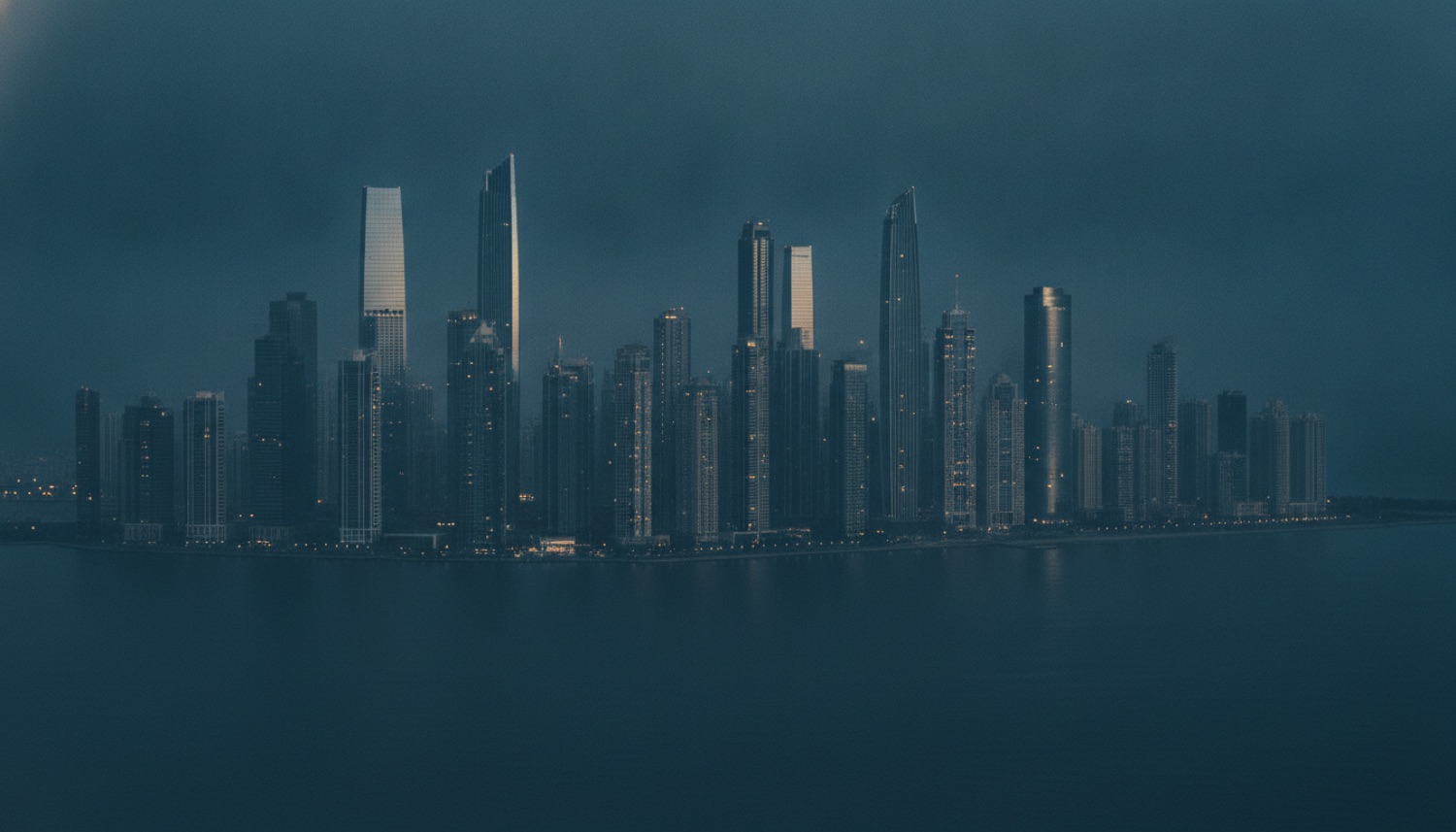
Waterfront & Beachfront UAE: The Blue-Zone Premium Report
From Palm Jumeirah to Saadiyat and Al Marjan, sand and sea frontage command the most durable premium in UAE real estate, and the shoreline is running out.
Beachfront and waterfront addresses carry the most stable premium in the UAE, typically 40 to 60% above inland comparables, because coastline is finite and increasingly reclaimed at high cost. Palm Jumeirah psf now averages above AED 4,200, Emaar Beachfront and Dubai Islands are scaling fast, and Saadiyat anchors Abu Dhabi's blue-zone story. This report maps where the water premium is deepest and most defensible.
Why the water premium is different
Every prime market has a scarcity story. In the UAE it is literally the coastline. Natural beachfront is finite, and the alternative, reclaiming new land from the sea, is slow and expensive, which is precisely why the water premium is the most durable in the market.
The premium is not a single number; it scales with the *quality* of the water relationship. A sea view adds around 22% over an inland comparable. Genuine waterfront lifts it to roughly 38%. A private marina berth pushes it near 47%, and direct beach access, sand you can walk onto, commands 54% or more. Private beach frontage, the rarest tier, clears 60%.
Dubai has manufactured its own supply through engineering. Since 2001 the emirate has reclaimed roughly 92km of new shoreline, from Palm Jumeirah to the newer Dubai Islands, each project adding frontage that did not previously exist. But reclamation has a ceiling: it is costly, environmentally scrutinised and finite. Every new frond or island is a one-time addition to a fixed natural stock.
That is the core investment case. Inland, developers can always build another tower on another plot. On the water, the supply is capped by geography and engineering economics. Scarcity that cannot be manufactured away is what makes the beachfront premium defensible across cycles, and why it narrows far less than inland pricing in a downturn.
The waterfront premium scales with the quality of the water relationship, from around 22% for a sea view to 60%-plus for private beach frontage.
The read
The Dubai shoreline, address by address
Dubai's waterfront divides into distinct tiers, each with a different buyer and yield profile.
The trophy tier
Palm Jumeirah remains the benchmark, averaging above AED 4,250 psf and setting the UAE's villa price records on its frond tips and Signature Villas. Supply is effectively fixed, which is exactly why values have compounded steadily and stepped up post-2021 on branded launches like Six Senses and Armani Beach.
The scaling tier
Emaar Beachfront, a gated marina-and-beach enclave between the Palm and Dubai Marina, trades around AED 3,450 psf and offers the most liquid branded-adjacent beachfront product. Dubai Islands, the reimagined former Deira Islands, is the growth story at roughly AED 2,650 psf, with a long beachfront runway and a lower entry point.
The frontier tier
The Jebel Ali coast and Dubai Maritime City represent the next reclamation frontier, entry-priced today but dependent on infrastructure delivery.
The yacht-and-marina lifestyle threads through all of it. A berth is not an amenity here; it is a price multiplier. Buyers paying for beach access are usually paying for marina access too, and the two together define the top of the Dubai waterfront market.
Abu Dhabi, RAK and the yield question
Dubai does not own the UAE waterfront outright. Abu Dhabi's Saadiyat Island is a genuine rival at the top, averaging around AED 3,600 psf, and it competes on a different proposition: low density, protected natural beaches, and cultural anchors including the Louvre and the Guggenheim. Saadiyat sells calm and permanence where the Palm sells spectacle.
Ras Al Khaimah's Al Marjan Island adds a third pole at roughly AED 2,080 psf, where the beachfront thesis compounds with the 2027 Wynn integrated-resort catalyst, a rare case of two premiums stacking on one shoreline.
The yield case
Beachfront is not only a capital-appreciation play. Prime UAE beachfront clears gross yields near 6.4%, and much of that is driven by short-term rental demand. Tourists pay a steep nightly premium for direct beach and marina access, and platforms have made STR operation straightforward for owners. A well-run beachfront apartment can outperform a long-let inland unit on income while still capturing the appreciation.
The caution is concentration and service cost. Waterfront service charges run high, salt-air maintenance is real, and STR income is seasonal and tourism-dependent. But with roughly 68% of prime buyers naming water access as their single decisive factor, demand-side support for the premium is structural, not sentimental. On the UAE coast, scarcity and desire point the same direction.
- 01The waterfront premium scales with the quality of the water relationship, from around 22% for a sea view to 60%-plus for private beach frontage.
- 02Coastline is capped by geography and costly reclamation, making the beachfront premium the most defensible in the UAE across cycles.
- 03Palm Jumeirah anchors the trophy tier above AED 4,250 psf; Dubai Islands and Al Marjan offer the same thesis at a lower entry point.
- 04Prime beachfront yields near 6.4% gross on short-term-rental demand, but budget for high service charges and salt-air maintenance.
Turn the data into a shortlist.
Our desk maps every trend in this report to live stock. Send your brief and get a costed shortlist the same day.
WhatsApp the desk →